
Kingman City Directory Holdings
Kingman's verified historical spine is short but strong. The State Research Library's Arizona Memory Project collection provides three R.L. Polk volumes. They are dated 1937, 1961, and 1963. Each uses call number 917.91DC K549 and OCLC 010990546. FamilySearch International digitized the volumes in March 2022. The item pages offer searchable optical character recognition, or OCR, plus downloadable page images and a public-domain statement.
| Collection | Years | Where Held | Access |
|---|---|---|---|
| R.L. Polk Kingman volumes | 1937, 1961, 1963 | State Research Library | Free OCR and page images |
| Mohave County Miner | 1882–1918 online; 1916–1977 microfilm noted | Arizona Memory Project and museum channels | OCR leads; verify the scan |
| Kingman Sanborn map | March 1916, five sheets | Library of Congress | Free digital sheets |
| Union High School yearbooks | Objects grouped in the 1930s, 1950s, and 1960s | Arizona Memory Project | Online item inspection |
| Mohave Museum Research Library | Series vary | 400 W. Beale Street | Appointment with archives staff |
The three Polk volumes are surviving access points, not proof that only three editions were printed. No verified first or last publication year supports a seamless timeline. The online gap between 1937 and 1961 is real, as is the gap after 1963. A careful search records what was checked instead of treating an absent digital edition as an absent historical record.
The Arizona Memory Project collection screen shows where the digitized Kingman volumes live.
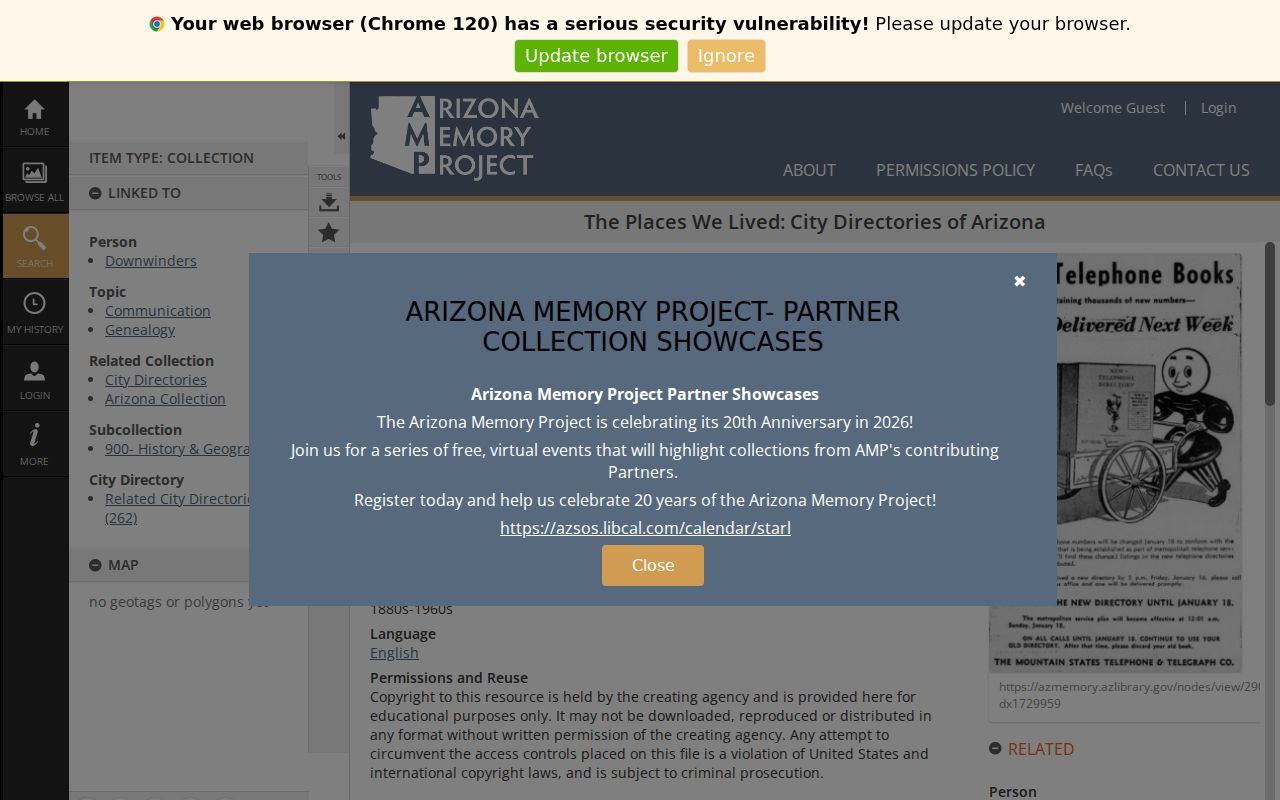
That collection is the best online starting point, while local staff and catalog work are needed for material outside the three verified volumes.
Decode a Kingman Directory Entry
A 1961 OCR result reads approximately “Sheets Lewis (Ruby; Arizona Motel) h E Andy Devine.” It joins a surname and given name to a spouse, business tie, home marker, and street. Yet the OCR fails to preserve a reliable street number. The page image and that volume's key must control the transcription. Other entries may include “Mrs,” a trade, employer, telephone number, and marks used by the publisher. These details are clues from an annual canvass, not a government certificate.
| Name | Surname and given name as printed, sometimes with an initial or title |
|---|---|
| Spouse | A name in parentheses can connect two people in one entry |
| Work | Occupation, employer, or business association may follow the name |
| Home | The abbreviation h marks a home or residence statement in the inspected entry |
| Address | Street and, when legible, number should be checked against the scan |
| Phone or symbol | Publisher marks must be read with the volume's own key |
Transcribe the print exactly first. Expand an abbreviation in a separate note. Record the PDF page and image page because they may differ. Then save the spelling, spouse, trade, business, phone, and address as separate facts. This keeps a faint number or poor OCR match from changing the whole Kingman historical citation.
- Criss-cross directory
- A directory arranged by street or telephone number rather than only by surname.
- Householder section
- The address-ordered part used to move from a street and house number to a listed name.
- Abbreviation key
- The publisher's legend that defines short forms and marks used in that exact volume.
- OCR
- Machine-read text used to find a page; the scanned print remains the evidence.
Search Kingman Directories Two Ways
The alphabetical section moves from a person to an address. Search the surname, try initials and spelling variants, inspect the scan, and then note everyone printed at the same address. The street or householder section reverses that path. It can reveal the listed names along one block and show whether an address appeared under a slightly different form. Search both the resident and the street because OCR may catch one while missing the other.
For current address-keyed work, the Kingman street directory workflow uses county parcel and deed records. Historical directories answer a different question. They show who the publisher recorded at a place in a given edition. A deed owner and a directory occupant may differ because the occupant rented, lived with family, moved near the canvass date, or used a mailing arrangement. That mismatch is evidence worth keeping.
Note: A directory listing is annual evidence, not proof that a named person occupied the address for the whole year.
Kingman Directory Metadata Puzzle
The item titled “1963 Kingman City Directory” contains a surprising catalog detail: its metadata states “Date Original 1961.” This does not create a fourth directory year, and it should not be silently corrected. Cite the titled item and call number, note the conflicting metadata, and describe the specific page used. That method lets another researcher reproduce the result without assuming which date field is wrong.
This small trap shows why the cover, title page, catalog record, and scanned entry should be kept together. File names and search snippets can flatten those distinctions. When a year drives a family timeline, compare it with a dated newspaper item, census schedule, deed, or vital record before deciding when a household reached or left Kingman.
Catalog tip. Preserve the displayed title, call number, page image, and conflicting date field in the same research note.
Trace Kingman Resident Records
A family-history search should treat each directory as one observation. The three verified Polk volumes can bridge names and addresses around public census years, but they cannot supply every year between them. The 1930, 1940, and 1950 federal censuses add household order, age, birthplace, and occupation. Newspapers, deeds, and death records can then explain a move, marriage, death, or change in trade.
- Search the surname and its likely variants in each available Polk volume.
- Open the page image and record the spouse, trade, business, phone, and full address.
- Check the street section to find other listed householders at that address and nearby.
- Pair the directory observation with the nearest public census and avoid assuming unstated relationships.
- Use deeds, obituaries, cemetery records, and newspaper notices to explain gaps or changes.
A missing name proves little by itself. The household may have moved, changed surname, declined to list, sat outside the publisher's boundary, or been missed by the canvass. OCR can also skip a clear printed entry. A conclusion becomes stronger when two independent records share a spouse, address, trade, or event date.
Kingman Directory Library Desk
The Kingman Branch Library at 3269 N. Burbank Street is the practical local reference point. Its phone number is 928-692-2665. Catalog and staff help can identify local newspapers, telephone books, yearbooks, cemetery publications, and county histories. Older government series may also require Arizona Archives and Records Management. The research does not verify exact physical year runs for each type, so ask staff to confirm holdings before planning an in-person visit or copy request.
The official Kingman Branch Library page supplies the source point for local reference help.
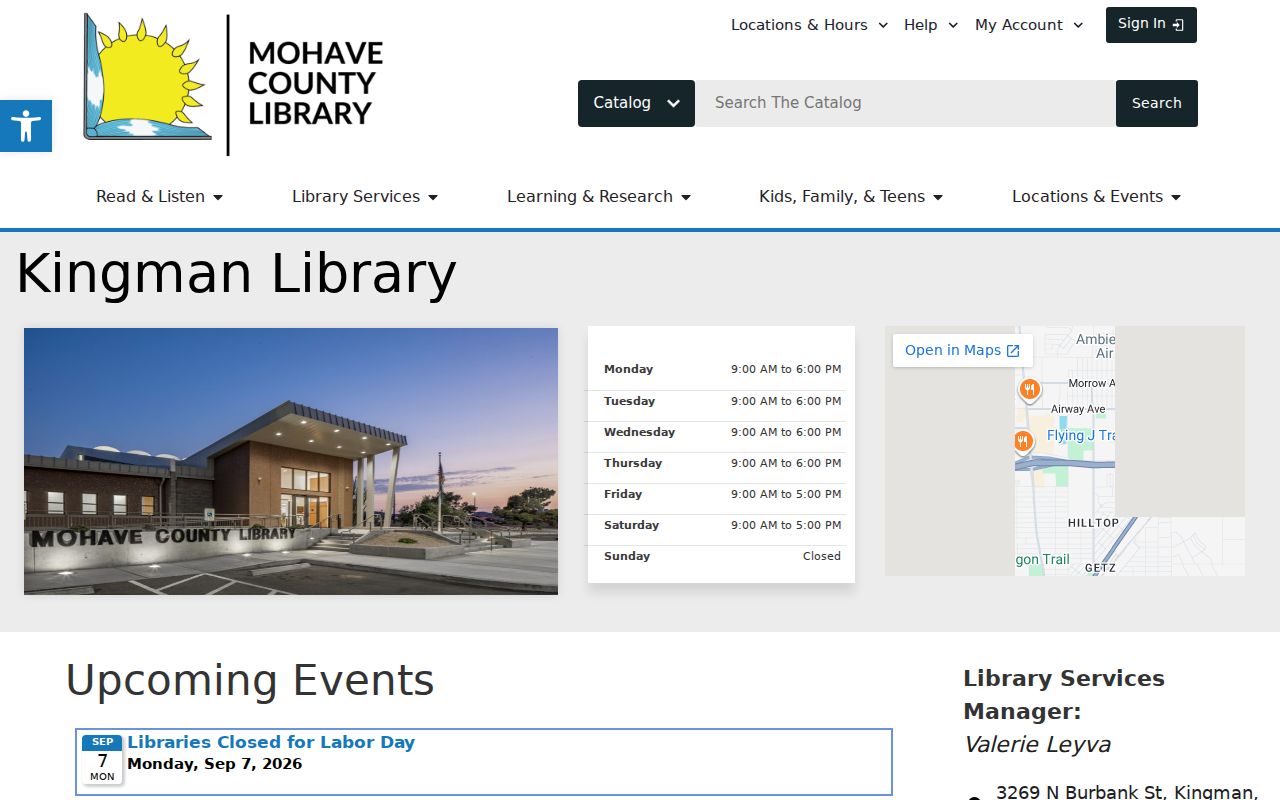
The branch can help bridge an online directory find to local newspapers and printed sources whose exact runs need staff confirmation.
Send a focused request. Include the surname, date range, known address, and source already checked. Ask whether an index, page scan, microfilm reel, or catalog item exists. This gives the librarian a record-shaped question instead of an open-ended search for every mention of a person.
Expand Kingman Directory Gaps
The March 1916 Sanborn fire map collection has five verified Kingman sheets. They show building footprints, materials, stories, property lines, street widths, and water or fire features. A Sanborn map describes the place, not its occupants. Pairing it with a directory, census, or newspaper can show whether two similar address references point to the same structure before modern permit files.
- 1864: Mohave County formed as one of Arizona Territory's original counties.
- 1882: The Mohave County Miner began publication at Mineral Park.
- 1887: The Miner and the Mohave County seat both moved to Kingman.
- 1916: The verified five-sheet Sanborn set recorded Kingman's built form.
- 1937, 1961, 1963: The three verified R.L. Polk volumes mark the online directory trail.
- 2022: FamilySearch digitized those three volumes for the State Research Library.
The Mohave County Miner fills a different gap. It began at Mineral Park in 1882 and moved to Kingman in 1887, the year Kingman became the county seat. Search obituaries, marriage announcements, visitors, mining and railroad reports, advertisements, and legal notices. The available online collection spans 1882–1918, while a preservation finding aid notes 1916–1977 microfilm. OCR is only a lead. Confirm the person and wording on the newspaper scan.
| 1916 Sanborn | Structure, use, materials, lot context, and period street names |
|---|---|
| Miner newspaper | Events, relatives, visitors, businesses, and legal notices |
| Federal census | Household order and person-level details for public census years |
| Polk directory | Annual name, address, spouse, work, and phone clues where printed |
Kingman Records at Mohave Museum
The Mohave Museum Research Library at 400 W. Beale Street holds thousands of Mohave County documents, manuscripts, maps, and photographs. Railroad, mining, ranching, school, cemetery, business, family, and Route 66 files can add context that an annual volume cannot. Its archive is volunteer-operated, telephone 928-753-3195, and open by appointment only. Ask archives staff to confirm the series and any copying limits before visiting.
The museum's archives overview introduces this appointment-based Kingman research channel.
The archive is especially useful when a directory name connects to a railroad, mine, ranch, school, local firm, cemetery, or known family file.
Arizona Memory Project oral histories add first-person context. George Fass discusses Kingman, ranching, mining, service, and city growth. Doris Cunningham recalls a 1950s move and Ford Motor Proving Grounds ties. Burton Carter covers a 1960s move, local groups, and the 1973 railcar explosion. These narratives enrich a known identity but are not a complete resident roll.
Kingman Directory Yearbook Links
The Mohave County Union High School yearbook subcollection contains three digitized objects grouped in the 1930s, 1950s, and 1960s. A yearbook can confirm a classmate's spelling, school year, club, team, faculty tie, or nickname. It often works best after a Polk volume supplies a household surname and address. A circa 1930 Harvey House employee photograph offers another local lead, though archive catalog work may be needed to identify names.
Yearbooks and oral histories are particularly useful for reconnecting family narratives and former classmates. They should be checked against dates and other records. The absence of a name does not prove a student or resident was elsewhere, since surviving editions and public digital holdings are incomplete. No public roster was verified for local congregations, lodges, unions, veteran posts, or alumni groups, so their membership should never be assumed open.
Note: Ask the holding institution for the exact year and item record before treating a broad decade grouping as a dated source.